Ancient Eyes pt. 2
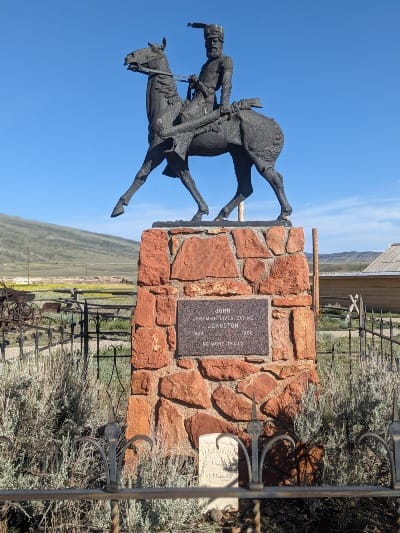
In the morning, I woke up to my alarm clock. Turning it off, I swung my legs out of bed and started to get ready. Within twenty-five minutes, I was dressed and walking with my belongings out to the car. Dropping the key to the room off at the front building, I began making my way to where the memorial was located. It turned out that someone created Old Trail Town, an old western town next to Johnson's headstone. Driving down the street, it seemed like I was the only person awake. The sun was coming up behind me from the east, illuminating a blue, cloudless sky. Within five minutes, I turned right off of the main road, then turning left, I pulled into the parking lot of the Town. After I had parked the car, I stepped out and began making my way to the entrance of the ‘town.’ I walked into the first building, paid the entrance fee, and then began walking down one of the plank sidewalks. I paused at each of the little buildings, looking at how they had set it, attempting to replicate what they had looked like in a time gone by. Eventually, I reached the plank sidewalk's end and turned the corner. Behind the building stood a tall memorial made from pieces of stone. On top of the red, brown, and orange colored monument stood a horse made of metal. On the horse sat a man, the reins of the horse in his right hand, a rifle balanced in his left. His steely, sightless eyes gazed down at whoever stood before him. A wrought iron fence guarded the tall sagebrush that stood at attention around he and his horse.
I stood there, looking at the memorial of the man I had become familiar with. History had told a story of a man who, after his native wife was murdered in the 1840s by the Crow Indians, waged a twenty-five-year war against them. The legend was that he killed more than three hundred Crow warriors. After killing each one, he removed and ate part of their livers, hence ‘Liver-Eating’ Johnson. For some, he was a folk hero and legend. For others, they might see a madman or murderer. How could I come to terms with Johnson as a folk hero on one hand while witnessing the lead up and aftermath of another Native American brutally murdered at the hands of white men with little to no consequence? After a few more minutes, I turned and retraced my steps to the car. Eventually, sitting in the driver’s seat again, I looked at my phone. I had begun to get hungry, so I thought I would stop at a coffee shop and get something to eat before heading onto the road. Looking at the maps app, I saw a place along the main street called Beta Coffeehouse. I made the decision that that was where I would stop. I pulled out of the parking lot and went back through town, eventually pulling in front of the coffee shop.
The shop was a long, narrow building. The inside of the building had an eclectic-hippy feel. I made my way through the shop to the front counter in the back right corner of the room. Standing in line, I looked around at all the decor on the walls. Suddenly, the door jingled open behind me. I turned slightly and glanced at who was approaching. What appeared to be a family came through the door. A young man led the way. Behind him came a wheelchair with a very old man, pushed by an older lady. Behind her was what appeared to be her partner. The young man made his way through and stood behind me. The lady, whom I assumed as the young man’s mother, parked the wheelchair at the table against the wall, closest to the counter. It was finally my turn. ‘Can I get a medium hot latte and also a bacon, egg, and cheese bagel?’ I asked. ‘Sure,’ the young woman responded from behind the counter. ‘Is there anything else? I hesitated for a moment and then responded, ‘No.’ Giving her my name and swiping my credit card, I stepped away and waited for my order to be ready. I glanced around and noticed an empty table for two nearby. I stepped over and sat in the chair facing the rest of the shop. Sitting there, I began to observe the family that had come in behind me. They appeared to be of Native American descent. The old man in the wheelchair sat at the head of the table. The two older adults sat on the left side of the man. After he had ordered, the young man sat down on the man's right side. ‘Nate.’ I looked over as I heard my name. The young woman at the counter was standing there with my latte and sandwich. I got up and took the order from her. As I turned around, I looked at the hat the old man was wearing. It was a bright red side hat with yellow borders. On the left front and backside of the hat were medals. In the middle, stitched in yellow, read ‘Navajo Code Talker.’ I instantly knew that at that moment, I was in the presence of living history. I was simply in awe. I walked back to the table and sat down. While eating the sandwich, I watched the old man and his family. He stoically sat in the wheelchair. He wore a long-sleeved yellow shirt under a red vest, the same color as his hat, decorated with medals. His pants were a dark olive green. It appeared that he was wearing his military uniform. A flood of thoughts washed over me. The first one was a mental kick to myself. I hesitated when I paid because I had briefly thought about doing a random act of kindness to the family before I realized who any of them were. Then I thought about approaching them; it was not something I really did much of. If I did, what would I even say or ask? I sat there mulling over the different thoughts while finishing my breakfast. It dawned on me that I had not even noticed if what I was eating was good. Taking the last couple of bites, I stood up. Picking up the tinfoil that the sandwich had come in and the cup of latte, I walked to the trash can and threw away the foil. I turned and began walking towards the door. Abruptly, I stopped, turned, and walked up to the table where the family was. ‘Excuse me,’ I gently interjected. The family looked up at me. I looked down at the old man and asked, ‘Are you a World War II veteran?’ ‘He is hard of hearing.’ I glanced over and looked at the older woman who had said it. ‘Oh, I am sorry.’ I responded. She nodded along with the older man that she introduced as her husband and the young man who was a grandson. ‘You have to speak louder; he is hard of hearing,’ she continued. I looked back at the old man and, in a louder, stronger voice, stated, ‘Thank you for your service.’ He looked up at me and reached out to meet the hand that I had extended. As his hand enclosed around mine, he responded in a quiet but steady voice, ‘We did it together.’ I bowed my head in respect. I then turned, nodded my head concerning the rest of his family, and walked out of the coffee shop.
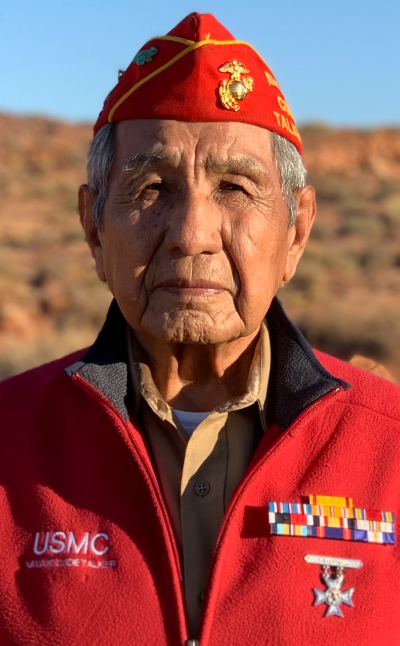
Opening the car door, I realized that I had not even asked what his name was or taken a picture with him. ‘Oh well, I am glad I did not ask for a picture,’ I thought, 'But damnit Nate, you could have at least asked for his name.’ I opened Google and typed in ‘surviving code talkers World War II.’ It came back that only three code talkers remained alive. As I looked at the pictures, I saw the face whose eyes I had just looked into in the coffee shop. His ‘christian’ name was Peter MacDonald, his real name in Navajo, Hashkasilt Begay (He Who Clasps With Power). The man, while raised among traditional shepherds, had been groomed to be a medicine man before enlisting in the Marines. I turned on the car, looked in the side mirror to ensure no one was coming, and then pulled out.
Three images of men floated in my mind. The face of a murdered man because he was homeless and of Native American descent. The face of a folk hero due to his murderous deeds and being on the conquering side. Lastly, the face of a man who was willing to go to war, using the very language that he was loathed for. The very same man was willing to fight for the country where, in many states, he was not allowed to even vote. Sure, the Indian Citizenship Act of 1924 had been passed, granting citizenship to the different tribes*. When this happened, though, many states passed laws that made their votes ineligible. Hashkasilt Begay and the other Code Talkers could be martyrs for one cause, for the greater good, but they were still just Indians for anything else, deemed as not worthy of having a voice.
Why must our martyrs be the very people whom we as a society mocked, overtly hated, and or killed? Must we wait until they are dead to show them the necessary respect and or listen to? Who are our folks heroes and who are our martyrs?
Sitting Bull, Geronimo, Pocahontas, Jim Thorpe, Tecumseh, Maria Tallchief, Black Hawk, Chief Joseph, Wilma Mankiller, Squanto, Cochise, Joy Harjo, Red Cloud, and Sarah Winnemucca.
The Code Talkers: Choctaw- Solomon Louis, Mitchell Bobb, Ben Carterby, Robert Taylor, Jeff Nelson, Pete Maytubby, James Edwards, and Calvin Wilson
Comanche- Charles Chibitty, Haddon Codynah, Robert Holder, Forrest Kassanavoid, and Wellington Mihecoby
Navajo- Charlie Sosie Begay, Roy Begay, Samuel H. Begay, John A. Benally, Wilsie H. Bitsie, Cosey S. Brown, John Brown Jr., John Chee, Benjamin Cleveland, Eugene R. Crawford, David Curley, Lowell S. Damon, George H. Dennison, James Dixon, Carl N. Gorman, Oscar B. Ilthma, Allen D. June, Alfred Leonard, William McCabe, James Manuelito, Chester Nez, Jack Nez, Lloyd Oliver, Frank D. Pete, Joe Palmer (AKA, Balmer Slowtalker),Nelson S. Thompson, Harry Tsosie, John Willie, William Yazzie, Peter MacDonald
*https://www.loc.gov/classroom-materials/elections/voters/native-americans/
Member discussion