Black Fox Road to Andersonville
For many individuals, the idea of American history, let alone world history, can be dry, dull, and boring. They may not like it simply because it is written by those who have conquered, omitting wrongs that were committed to achieving future successes. This, the conquering and omissions, is the paradox of time. Would one be able to connect with figures from history if a person heard relatable stories, even if the benefit was from another's demise?
Through stories, people are transported to another time and place. It might be sitting on a makeshift raft floating down the Mississippi River. It might be walking through a short grass prairie, gazing off into the vast rolling hills. Nothing in the distance as far as the eye can see except the grass dancing, swaying back and forth like a waltz, as a gentle breeze touches each blade.
One might be crouched in the middle of the Rocky Mountains, covered in a buffalo hide, attempting to gain warmth from the raging wind and snow that roars around them, or they might be trudging through burning sand, a scorching sun blazing overhead, their tongue stuck to the roof of their mouths. Their cheeks and lips chapped and sunburned.
They might be standing on a ledge overlooking a vast valley. In the distance, whisps of steam float towards the skies from thermal springs, and buffalo graze in giant herds on the valley grass.
They may be standing still, facing a line of people who walk by, with the look of lost hope and a way of life tattooed in their eyes and minds as they walk the Trail of Tears.
It could be standing in the middle of a cotton field, with the faint feeling of callouses on their fingertips as their calloused thumbs rub against them. Their eyes peer over at the bent-over form of a person near them. The sun beats down on the mangled scars etched into the person’s back.
People learn, understand, and grow through stories. In those stories, an individual might find a conviction for the wrongs committed and endeavor to make them right. Whether good or bad, the stories must be told. We must not erase the stories of history, for by erasing them, we will be destined to repeat them.
The following writing is a blend of my writings along with the writings of my grandfather, who penned his own words more than forty years prior, based on stories of the family through the generations. This is a story of a time in this nation’s history when politics divided families and friends. Brothers fought against and killed each other. Fathers killed sons, and vice versa. Friends became enemies and killed each other. The story occurs during the Civil War and multiple generations after those consequential events.
‘Mary Barger was the eldest child of a Pennsylvania Dutch family headed by Philip Barger, who had crossed the Appalachians early in the l80O's. Philip's farm was located near the Black Fox School, and the family spoke German as their native tongue.
Robert McGarrah was one of two sons of the Scotch-Irish McGarrahs, whose farm was located near the Barger farm. Robert and Mary were married in 1860 and moved into a log cabin near the Black Fox road. When President Lincoln issued his call for volunteers for a "three-month enlistment" in 1861, Robert answered the call, and Mary returned to live with the Bargers. There, a few months later, she gave birth to their daughter, Martha ("Mattie") McGarrah. Robert's "three-month enlistment" turned into years, mainly spent helping defend a coastal fort at Plymouth, North Carolina.’
Robert did not come from wealth nor did Mary. Both came from families that relied on working the land and relying on the gifts that the inflexible earth gave them. A man of shorter stature, he was described as standing 5'5" with 'light' hair. Through a letter that he sent to his wife while away, one can surmise that he had received some formal education. In it, he talked about how it seemed like he would return home soon. He also instructed Mary on what to do with the farming, including taking care of the potatoes that had been planted. What was not written was that he was moving up the ranks in the 103rd, eventually gaining the title of corporal.
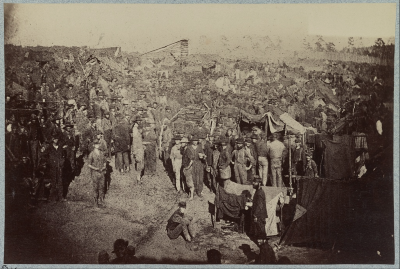
‘In 1864, the Confederates attacked the fort, and the Federals, after running out of ammunition, surrendered.’ The Civil War Plymouth Pilgrims Descendants Society of Plymouth, North Carolina, states that Union General Henry Walton Wessles surrendered to Confederate General Robert F. Hoke on April 20th, 1864. The Writer’s grandfather further explains in his writings, ‘They would have been better advised to hold out, for they were sent to the now notorious prison at Andersonville in lower Georgia. An eyewitness account at Andersonville reported that, when the unit of garrison soldiers was herded into the squallid enclosure, the ones already there thought the South had captured a "regiment of Brigadeer Generals". Robert survived at Andersonville for a year, and in March of 1865, six weeks before the peace, he died. Starvation and disease were widespread within the walls of Andersonville, whose history is well-documented.’
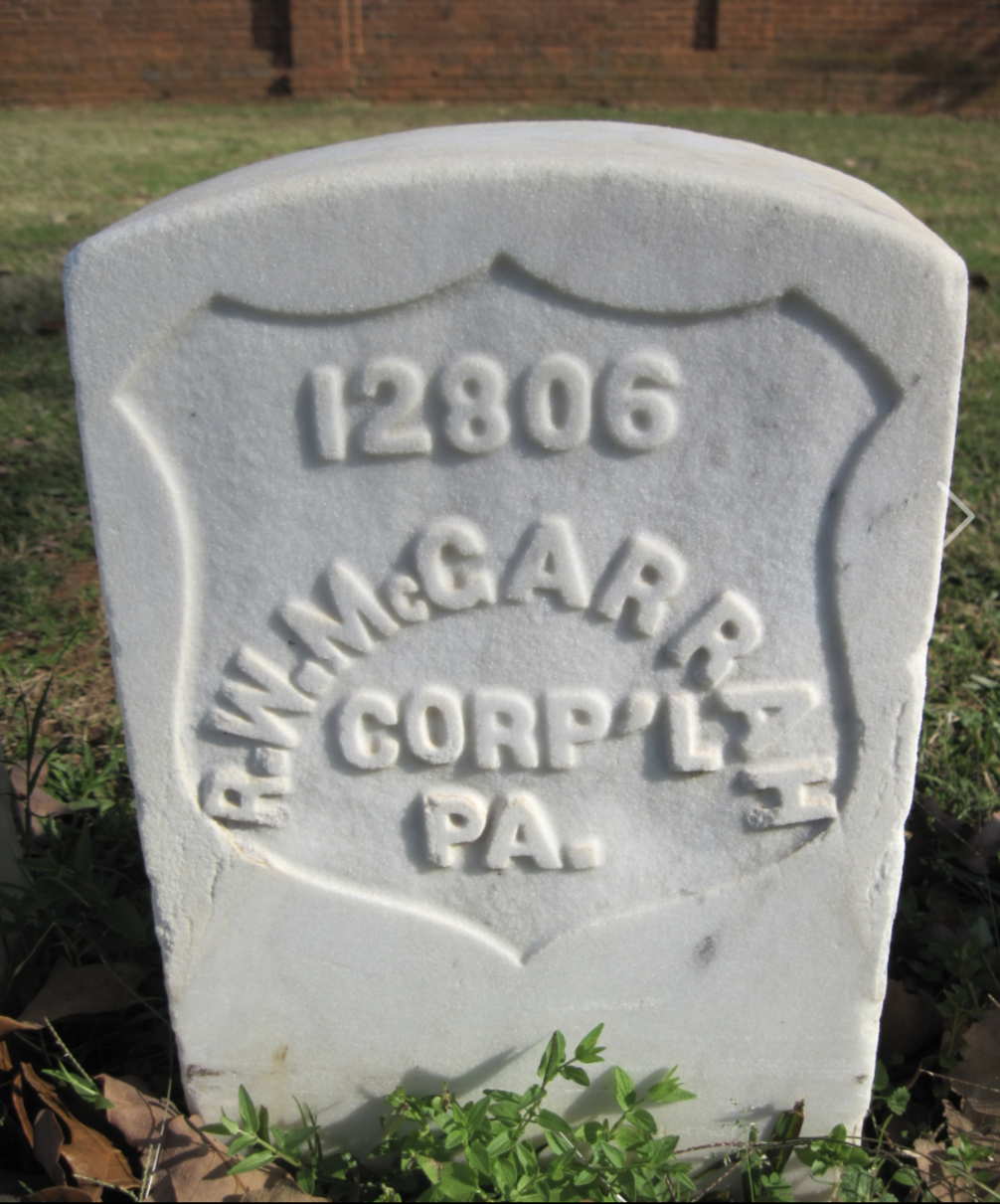
Of the men in the 103rd who were sent to Andersonville prison, this included a man by the name of William D. Keefer. Standing 5’ 9”, William lived south of Parker, Pennsylvania, on the Allegheny River. Though there is no proof, there is almost certainty that he knew Robert McGarrah and may have very well been friends with him. After being captured and spending nearly a year in the notorious prison, he was exchanged to the North on February 28th, 1865. It is stated that when he was paroled, he only weighed ninety pounds. Robert died in Andersonville and was buried in a grave there at the prison, which, today, can be found under the headstone marker 12806.
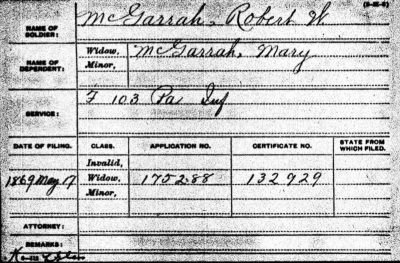
‘Robert died without ever seeing his daughter, "Mattie," who was then three years old. Mary Barger McGarrah raised her daughter with the Bargers, and she never remarried.
She lived in West Freedom on a modest Civil War widow's pension. In her later years, Mary’s daughter "Mattie', by then also a widow, joined her and cared for her. Mary was a familiar figure in our childhood before she died at 93 in June 1930. She is buried at the Concord Cemetery.’
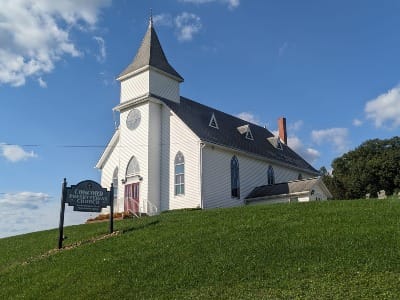
The years morphed into decades, and generations came and left the hills in that little part of Pennsylvania. Nothing is known of the log cabin on Black Fox Road. There are no answers for why Mary went and lived with her family instead of Robert’s or why she never remarried (though the Writer feels that strong personalities played into the decision-making).
Though the story took place a hundred and sixty years ago, it is important to see certain trends that are occurring in this day. Politics have poisoned families and friends. Mistrust is rampant in regard to much. May we work not to allow our relationships to become divided.
Member discussion