The Island pt. 3
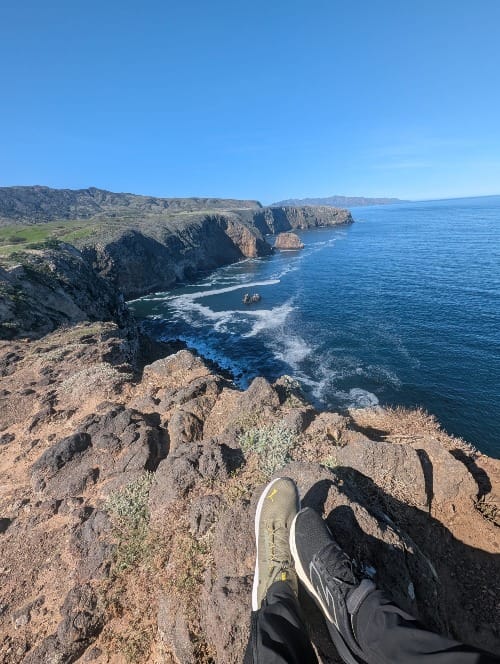
As we continued hiking, we decided that, after the unexpected fox sighting, the next place we wanted to hike to was a point of interest called Cavern Point. As we hiked up to it, the terrain became increasingly rocky, with little to no vegetation. At the top, it plateaued, and we were left looking out at the ocean on what seemed like a peninsula. In front of us was simply the blue ocean. Standing there, looking down, flocks of pelicans flew in lines below us as the ocean waves crashed against the rocky base of the island to the left, right and directly below where we stood. I straightened up and turned, gazing at the plateau again. In the middle of the plateau, stood a crumbling cement pillar. Centered, on top of it, was a marker with the wording, ‘U.S. Coast & Geodetic Survey.’ Having walked around the entire area, we returned to the main path and continued towards Potato Harbor Vista Point.
The hike was a very easy, pleasant one. Aside from one area of hiking down a hill and up another, we had reached a plateau and were walking on a reasonably flat surface. We came to a section where the path ran through an area to the right of us with short, green grass growing. It had a natural bench to sit and lean back while looking at the coastline. We continued and eventually made it to Potato Harbor, a natural inlet, although there was no obvious way to hike it. The area was quite beautiful, but it was also the first place where we encountered a larger number of people, four. We both looked over the area and agreed that we wanted to return to the small natural bench we had passed earlier. After making our way back, taking our backpacks off, we pulled out the towels and placed them on the ground where we would sit. The breeze was warm as it gently brushed against us. We had hiked a good three and a half miles and decided that we had finally found where we should have lunch. After eating sandwiches, some fruit, and chips, we lay back on the ground, enjoying the sunshine while listening to the crashing of the surf below us. What was so captivating about the place was its simplistic quietness. We had stepped off the ferry onto the island with a hundred other people, and three hours later, it was as if the place was our island. As we lay there, I could hear the sound of crickets off in the distance. It seemed odd as it was only March, but I would take it. There we lay, not a cloud in the vast area, looking into the blueness of the sky as if it were a mirror of the ocean that surrounded us. It was as if we had been transported back to our childhood when we looked for the puffy clouds that would suddenly come to life, like figurines in a slow-motion waltz. Time seemed to slow down with the rhythm of the moment. It is these special moments that I believe people often look for and, if not aware, miss.
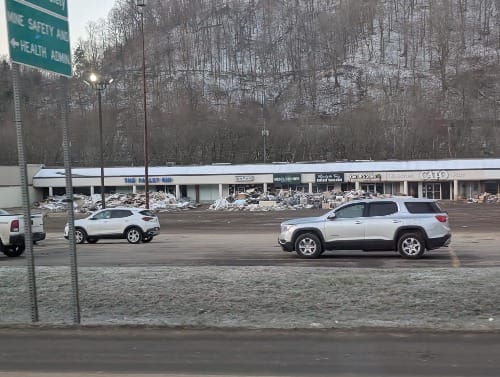
In that moment, I was transported back to the previous month. I was sitting at the hotel dining room table near the Louisville Airport in Kentucky. I had just completed a fourteen-day deployment with one of the largest relief agencies in the United States. The deployment had taken me into the heart of what had been the United States' coal country. I had been sent there along with others after catastrophic flooding had hit the area, killing more than twenty-four people. A large number of people had been displaced due to the flooding. Eventually, many left the makeshift shelters and returned to salvage and repair the places they called home. Others, though, did not have the support or stability. It was reported that the flood waters had reached depths of twenty-five feet. The devastation in its wake included mobile homes precariously placed in trees, while other homes were completely gone. Drinking water was non-existent in many areas. To exacerbate an already hazardous situation was that the flooding had occurred at the beginning of February, which meant that temperatures continued to drop below freezing, and included snow. Medicine was hard to come by. The county had run out of basic medicines, including tetanus shots.
The location of the shelter that two people and I were sent to was in the county high school, located in the largest county of the state, bordering West Virginia, Virginia, and Tennessee. The population staying in the shelter was made up of families, couples, and single people. The ages ranged from three years old to seventy. The one commonality that all of them had was that they were poor. Some, were as most people would describe as hillbillies, though I shy away from that description and would tell them simply as mountain people.
I learned quickly that most of these people had a situation similar to what I had seen growing up. The area supported the country for generations, both on the backs and in the lives of families there. In one sweeping moment, one decision, the coal companies had been closed down, leaving everyone in the area wanting. Many people could only afford to live in the regions that were deemed floodplains and thus could not get flood insurance.
Leroy visited me the first night while I stayed up, ensuring the shelter was safe. He made fresh black coffee and then explained that he was in the process of dying. The doctors had told him that the cancer had spread throughout his body and that he was terminal. He spoke of having the dream that you might of heard of, that cold, dark road, seeing his mama off in the distance. That he had already picked out his casket. His voice cracked, and tears ran down his cheeks. He said he did not want to go into hospice care because it seemed like he was giving up, but what options did he have now? He was stuck in a shelter surrounded by a few belongings that he and his wife had been able to salvage, including their cat.
Bobbie-Jo was five months pregnant. Her partner was with her but was in the process of detoxing from fentanyl and pills. Her partner had had sobriety, but the events of the flood had triggered him, and he had given in. As I was checking outside the building, I came upon Bobbie-Jo while she was smoking. She started talking about having two other children, but the children did not live with her and her partner. She said she tried to care for them, like having them drink Kool-Aid instead of Mountain Dew, but they would not listen.
Jimmie was a tall, skinny young man around thirty-two years of age. When you looked at him, it looked as though a person had taken a skin and wrapped it tightly around bones. Jimmie had been battling brain cancer for more than five years. His mom was there with him, attempting to make him feel as comfortable as possible. He talked about how it had been years since he had been in the high school gym he was now in. He had attended the school but had dropped out in high school. He told me that in the ninth grade, he was in a car accident with his little brother, who ended up being killed. He talked about enduring harassment from other kids who taunted him when he eventually made it back to school, and so instead of trying to endure it, he had dropped out. Later that evening, Jimmie was transported to a local hospital after having a seizure on the front sidewalk of the high school. When he and his mom came back from the hospital, he looked at me and asked, 'Why am I even drawin' breath? Can't hardly make it on my own two feet. Them seizures keep a-comin'. My mama and I lost our one and only roof over our heads. Ain't no way to live, I tell ya.'
Matt was one of two individuals staying in the shelter because their building caught fire and burned down. In a shaky voice, Matt talked about how he had been blinded by the smoke and had felt the heat of the fire because he had been trapped in his apartment. 'Look at my mug. That dang fire burnt my brows clean off. I thought I wasn't gonna make it.' His voice cracked with emotion. 'Then I heard a voice, in the middle of al' that there smoke tellin' me to follow it. And a fireman come and rescued me. I truly thought I was a goner. Didn't reckon I was gonna make it. Ain't no way I wanted to die in that fire.' He continued, 'My brother and my daddy both passed on from heart troubles. An' my momma, well, she went 'cause of them diabetes mess-ups. I'm the last one left in this here family. I sure ain't lookin' to go out in a fire.' With that said, he choked up, and tears ran down his cheeks. I put an arm around his shoulders, comforting him. There have been different moments that I have encountered when you do not have any words, or the words you do have just sound hollow, and so you simply are there in silence. Here was a man who had just come face to face with Death. It was as if there were things on his chest that he had to get off, having been given another opportunity at life. After regaining his composure, he continued, 'I been livin’ in this here valley my whole life, never once strayed. But you showed up and helped me and all the other folks. I reckon we could be real good friends.'
I was greeted with more stories, including one about an elderly man who had become trapped in his car by the flooding water. He had been attempting to flee the raging waters with his faithful best friend, his dog. Realizing he was trapped, he saved his dog, getting the canine out of the car in time. However, he was not able to get out of the vehicle, and the raging waters claimed him as one of their victims.
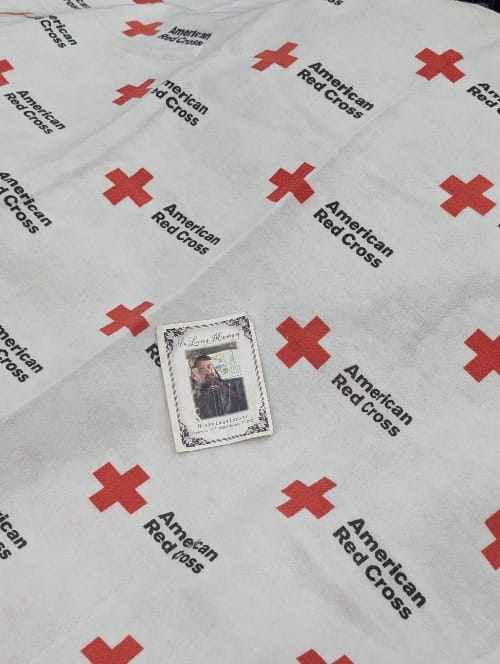
Then the woman came into the shelter looking for a warm meal. She explained that she had lost everything and was sleeping in her van. I explained that she was more than welcome to stay at the shelter. She thanked me profusely, then suddenly broke down crying. She reached into her pocket and pulled out a small card. I immediately knew what it was, as I had seen too many of them. On the memorial card was the face of a smiling man. 'This here was my husband. He fell back into it and died from an overdose. We laid him to rest the day them floods hit. He was a good man ya know? You believe me, doncha?' I gently agreed that I did, in fact, believe her. Every day she would leave the shelter, her bed immaculately made with his card on her pillows.
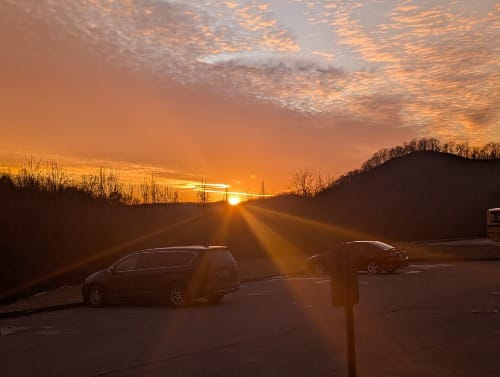
In the evenings, I often stepped outside, hoping to catch a glimpse of the sunset. Those moments reminded me that a new day would come.
Member discussion