The Upper Place: The Final Chapter
Beginning in the mid-1940s, a new form of coal mining was rapidly being implemented. We call it today, strip mining. This form of extraction of coal wreaked havoc on the land. The top layer of soil was often removed, the coal extracted, and the mining company moved on, destroying the land and water. It was said that the great injustice was that the mining companies promised the landowners fifteen or twenty cents a ton for the coal. What the landowner did not know was that the coal companies used their own trucks and scales to calculate the tonnage using their own sense of 'justice.' They had a 'license to steal,' and they knew how to use it. 'A classic remark by a local observer of the scene was that " the old-timers sold their heritage for a new car and a bathroom, and ended up with neither." With three to five veins of coal underlying much of the land, the family farms began to die. The farms of the Say's, McCalls, Stewarts, and many other families began to disappear, and in their places, ugly trenches bled into the streams, turning them sulphuric orange. In a few short years, there was no longer a clear stream in the area. To this day, there are few areas in North West Pennsylvania that have not been affected by strip mining.
As the years continued to roll by, the Say children began leaving, making their own way in life. Don enrolled in Carnegie Technical Institute (We know it today as Carnegie Mellon University), completing a degree in electrical engineering. This had been strongly 'advised' by his mother, Irene, who had at one point exclaimed, 'You are not smart enough to be a farmer, so you will have to be educated. I am going to make an engineer out of you!' Martha stayed in the area, marrying a family friend, Gerald Dunkle. Snooks moved to Washington, D.C., where she worked as a secretary for the local congressman. While there, she brushed shoulders with up-and-coming hot shots that went by names that included Kennedy and Nixon. Eventually, she moved to California and started a family, including a son, Mark, and a daughter, Julie.
Irene and Ed continued to farm the Upper Place with the help of their oldest daughter, Martha, her husband, Gerald, and their only son, Tom. In the 1950s, Irene and Ed agreed to allow a portion of the Upper Place to be mined at 20 cents per ton, but the coal was too deep for the equipment the mining company had, so they were only able to take a swath from the edge of the hill.
After holding out for nearly thirty years, along with much pressure and resistance, Irene and Ed agreed to allow a large portion of the Upper Place to be strip-mined. Irene insisted that the top hill portion of the land could not be mined and that the mining company would pay her outright instead of by tonnage calculated by the mining company's scales. After receiving the results of the core drilling, the company determined the average thickness of the coal seam. They agreed that the coal would be sold based on how many tons would be in a yard. Thus, coal would be sold by the acre. In doing this, the mining company also agreed that it would only be a ten-year lease. At the end of this time, they were to level off the hill created by the mining and reseed the area. With those strict boundaries, the company agreed to the contract, and after official signatures were penned, the company moved its machinery onto the land. With each scoop, an era ended.
Both Irene and Ed may have seen the elimination of small family farms coming, which is why they pushed their children in different directions. Both she and Ed had seen many changes, difficulties, and hardships. Whether it be immediate family members dying, the remnant aftershocks of the Civil War, the Great War, the influenza of 1918, the Great Depression, or the Second World War. They had seen hunger and had known poverty. They had faced retaliation with loss of jobs and wages due to political affiliation. Irene had tasted and seen the hardships of being alone, so she fought hard to make a place in this world for herself, her family, and the generations that followed. It required innovation and toiling while breaking open and planting the earth. With all of that, she saw her family grow through sweat, blood, and tears. Irene said goodbye to the love of her life, Edwin, in 1978. She, herself, left this little earth in 1986 at the age of eighty-five. In taking her final breath, she was reunited with her mother, Maude, whom she had lost at such a young age, and her father, Mack.
One might picture it now...
'The sky is streaked with pinks and reds as the sun slowly shows her face from behind the clouds. The breeze blows through the tall grass, causing it to dance as the light illuminates the individual heads of the tall grass. In the distance, a crow caws, looking at the young girl below him as barn swallows perform a rhythmic ballet, swooping through the air, brushing the tips of the tall grass. The young girl calls out to the cattle as she makes her way through the thorny brush. In the distance, up the hill, her mother calls from the house's front porch. 'Hurry up with those chores, Irene. You can't be late for school.' 'Ok, mamma, I am almost done.' she calls back. Quickly, using a stick like a shepherd's cane, she herds the cows into the far pasture, and after closing the gate, she quickly runs towards the house. Her mother greets her at the steps of the house with a smile and a pail with her lunch. 'I love you, mama,' she says, slightly out of breath. 'I love you too.' Maude response. She grabs the pail and runs to the barn. Unlocking the gate to the paddock, she lets out her horse, Ol' Bird. With the pail dangling from her wrist, she grabs tufts of main and swings herself up onto Old Bird's back. The heals of her bare feet press into the old horse's sides. Slowly, the horse makes its way out of the barn. The girl glances up the hill and sees her father walking behind his three-horse team, the jingle of their harnesses reaching her ears. He looks over his shoulder, and with a slight smile on his lips, Mack raises a hand to her. Slowly, the old horse turns and gingerly takes the routine steps toward the little one-room schoolhouse. At the school's entrance, the girl slides off the horse's back, throwing the lead rope over Ol' Bird's neck. As she walks into the schoolhouse, Ol' Bird turns to begin the slow trek back to the barn.'
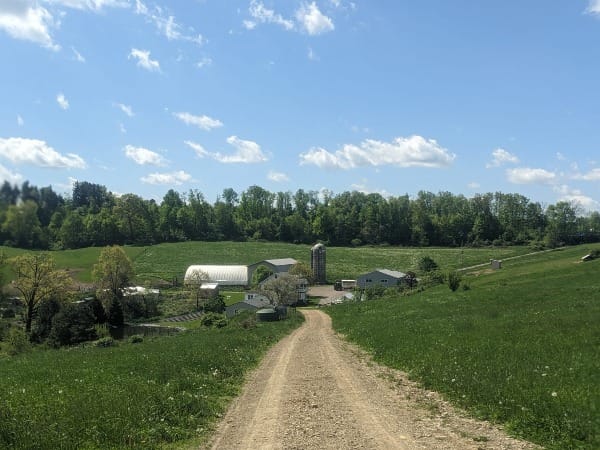
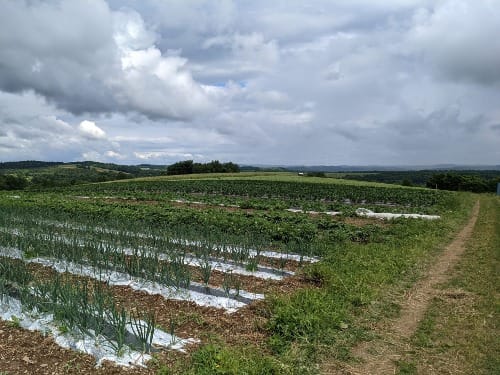
On a warm summer day, if one were to find the way up to the Upper Place today, they would be greeted with the same tall grass that has now covered over the scars that were left. The trees have begun to come back. At the top of the hill, after passing the pond, you will hear the same jingle of the horse tack. After years of being dormant and asleep, the land once again is being farmed. This time, an Amish family has leased the land. If you stand up top and close your eyes, the breeze will kiss your cheeks while the sun warms your shoulders. The sound of harnesses will reach your ears as the workhorses strain forward in their bridles and harnesses. The blade of the plow digs deep into the rich, dark earth, turning over fertile soil.
The organic produce that they grow is then shipped to Whole Foods in Pittsburgh and sold.
'The only unchanging thing on this little earth is change itself.'
Member discussion