
The Upper Place Pt. 2
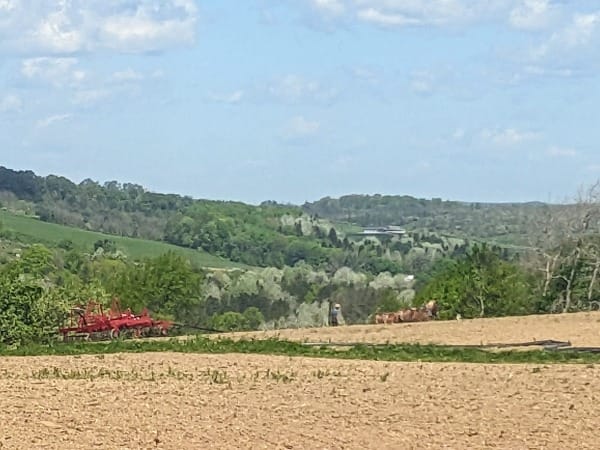
Irene spent the rest of her youth growing up and working on the farm. After meeting the requirements for completing secondary school, she graduated and then completed classes at the local college, where she received a teaching certificate. After a time of teaching, she settled down, eventually marrying Edwin Say and having three children: two daughters and a son: Martha, Don, and Margaret (fondly known as Snooks). By then, they were living along the hard road just outside Callensburg on a small farm five miles from the Upper Place.
At the time, the church played a pivotal role in the community, where a person could learn much of the current news. The Say's, being part of the community and also 'good Presbyterians,' attended the Concord Church. There, Don and his sisters met the first Black person in their lives. The man went by the name of Jimmy Parker. Jimmy was an old man when Don and his siblings met him as young children, though they could have sworn (of course not on a Sunday) that Jimmy had been in that area forever. He was a small man in stature, very likable and courteous, but also very quiet. Jimmy arrived one day in the small town of Parker, having followed the railroads north as he looked for work. Jimmy was illiterate, not knowing his age, let alone being able to read or write. The Logue family eventually hired him on as a hand to work with them on the farm. Thus, they brought him to Concord Church every Sunday as good Presbyterians. When the older Logues passed away, Jimmy moved in with their son Oren and his wife Lottie. Lottie continued to take Jimmy to church every Sunday. Oren was never able to make it on Sundays. He raised fighting roosters- a noisy, raucous bunch of fowl in separate cages out behind the barn, and on Sunday mornings, they needed a lot of attention. Eventually, when Jimmy passed from the scene in 1940, as a very, very old man, he died a free man. He had made his way north after the Civil War with a band of formerly enslaved people, and when he stepped off the train in Parker, he ended up with the last name Parker. When Jimmy died, he left a hole in the church. Don would often mention Jimmy and how, when Jimmy left this world, he must have gone to where good people go. He said Jimmy was probably sitting on the right side of the aisle next to the potbelly stove, a free man, a free man indeed.
One weekend, when the three children were older, and after much insistence from Ed, it was decided that they would go to Parker, a town over, where they could see the new movie that had hit the theaters in the area, titled Gone with the Wind. This was a movie that Ed had been wanting to see. Somehow, Irene scraped together $1.25 for the whole family to see it, 25¢ a person for admission. At one moment in the movie, Rhett carries Scarlett upstairs to the bedroom. It was at this moment that Ed declared that society had been flushed down the toilet and promptly walked out of the theater to sit in the car. Now, Irene and the kids remained inside, watching the rest of the movie. The children thoroughly enjoyed the movie, and Irene because, well, she was going to get every last penny worth of money out of the four hours at the theater. I believe it gave Ed plenty of time to contemplate societal norms and the depravity of man.
The years passed, and Mack, in his mid-60s, died in 1942. In his will, he offered Irene the choice of taking the Upper Place or a thousand dollars; Irene chose the Upper Place. As the United States became more involved in World War II, the cost of produce began to jump, so it was decided that the family would farm the Upper Place again. Much of the produce would be sent down to Pittsburgh and sold at the markets in the city. Before long, farming was up and going again at the Upper Place. The family kept a herd of Hereford cattle up there, along with a couple of fields for planting, including corn and hay. In the winter times, it was no easy task getting up to the land. So Ed would attach chains with twisted links to the tires of a little gray and red Ford tractor that he owned. That usually would do the trick for getting him up to the land. In the summertime, you would find the family up at the Upper Place bailing hay or mending fences.
Like many families of that era, the time came when Don graduated high school and enlisted in the army. He was shipped off to boot camp at Camp Roberts in California and then, after a brief visit home, was sent to fight in the European Theater. Ed, having served in France during 'The Great War' of 1914, knew firsthand the results of war. This was very true as his own grandfather had been Robert McGarrah, whom had died a prisoner of war during the Civil War. Now, his son left to fight again.
Member discussion