Uncle Dunkle
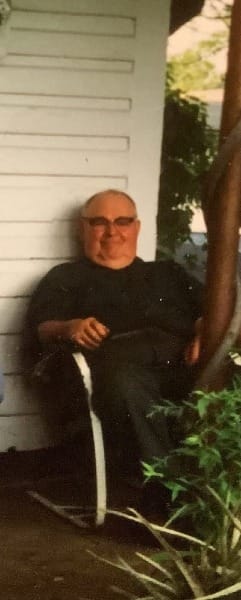
My Great Uncle Gerald was a special person. He spent his whole life in a little area known as Callensburg, located in Clarion County. Callensburg overlooks the confluence of Licking Creek and the Clarion River. Gerald grew up in the area and eventually married my Grandfather's sister, Martha Say. The two eventually had a son whom they named Tom, after Gerald's father. Gerald knew the land like the back of his hand, along with the people who lived in it and worked it.
At one time, the area was comprised mostly of little family farms, but the farms gave way in the mid-1940s to what my grandfather termed ' a creeping plague of earth-eating locusts.' For the reader who might not understand this description, it was in reference to strip mining. This form of extraction of coal wreaked havoc on the land. Oftentimes, the top layer of soil was removed, the coal extracted, and the mining company left, having destroyed both the land and water. It was said that the great injustice was that the mining companies promised the landowners fifteen or twenty cents a ton for the coal. What the landowner did not know was that the coal companies used their own trucks and scales to calculate the tonnage using their own sense of 'justice.' They had a 'license to steal,' and they knew how to use it. 'A classic remark by a local observer of the scene was that " the oldtimers sold their heritage for a new car and a bathroom, and ended up with neither."
In the 1930s and also in the 1940's, Uncle Gerald did a lot of hunting and trapping both for food and also to earn money. 'Dad used a .22 rifle that he bought at Sears and Roebuck. The way it worked back then was you could send in a bundle of furs like muskrat hides, mink, coon hides, or a mixture of different things, and Sears would buy them and then give you credit towards buying whatever you wanted (the reader must also understand that the meat from these animals was the protein that was consumed at the dinner table.) That is how he got his first 22 rifle. During WWII, he couldn't get ammunition, so he had to go back to using a muzzle-loading rifle and a muzzle-loading shotgun. He got a recipe someplace for making gunpowder. You used so much charcoal, so much sulfur, and so much saltpeter, and you mixed that up with water and then dried it in the oven. One time, he had a batch drying in the oven, and it went off, blowing the oven door off. He always said that the biggest groundhog he ever killed was during the war with a muzzle-loading rifle using homemade powder and a match head for a cap.'
In my grandfather Don's writings, an excerpt says, ‘A philosopher once wrote that the only unchanging thing on this little earth is change itself.’ This idea of change rings true as I sit in the corner of the house and reminisce about the family.
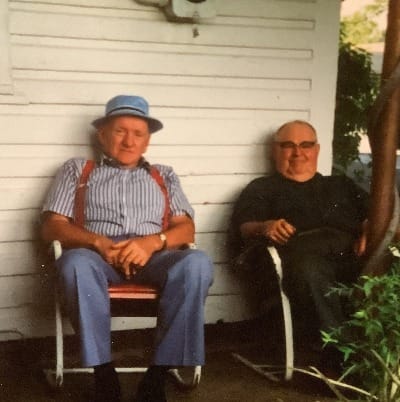
As my life changed and evolved over the years, when I often thought about the family, my mind always gravitated to Callensburg. The two images that usually came to mind in those moments were sitting on the back patio or front porch swing of Uncle Gerald and Aunt Martha’s house and spending time up at the Upper Place where my ancestors had worked the land (the two were very intertwined).
Some of those first memories involved the love and hate-moments with a little pony that Gerald had owned. The pony strongly embraced the former of those moments and was also fittingly named 'Buckie.' The memories also include coming to visit while we were living in Missouri. Grandpa Don brought me to Callensburg, and we stayed with his mother, Great-Grandma Say, who lived across the road from Uncle Gerald and Aunt Martha. While I ‘slept’ at Great Grandma’s place, I spent most of my time at Uncle Gerald's and Aunt Martha’s.
And so, the memories change and flash before the mind’s eye. I am standing in the schoolhouse with Uncle Gerald. He had bought the old schoolhouse in Callensburg and converted it into one of his workshops. While I stood in the schoolhouse, I realized he made baseball bats for the local kids. I asked if he might be able to make one for me. On one of the following visits to his place, he presented me with a brand-new wooden baseball bat. That was one of the best gifts I can remember. The scene fades away, and a new one appears from when he presented my father with a flintlock that he had built for him.
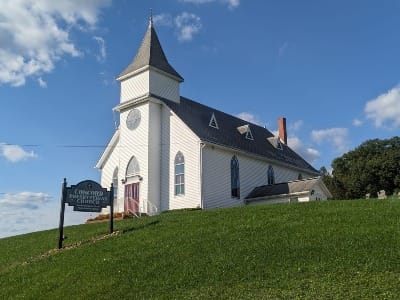
The mind's eye fasts forward, and we stand on the side of the hill at Concord Church cemetery, decorating the family headstones. It’s a warm, humid day. Whisps of clouds dot the sky as Uncle Gerald and Grandpa reminisce about the hills and valleys and the families that filled them. This was most definitely an important time to simply listen, as Gerald knew many of the stories regarding those hills, valleys, and families. I can hear him responding ‘Well, yes…’ in his slow drawl or ‘As a matter of fact…’
Another memory that comes to mind is of him taking me to camp in the fall of ‘98. I still chuckle about how my high school coach wanted to tan my hide for skipping the soccer game that week, but there was no way I would miss an opportunity to spend time with Gerald. Of course, anyone who spent time there knew how remote it was. We stayed there for four days. In the shadows of that cabin, he recounted the memories, the light dancing from the kerosine lamps. The stories drifted past the Red Barn and highlighted Tom Steenbergen, his eloquent sermons, and the Clay Spring camp. There were many deer ‘killed’ that weekend. It was there that he showed me the little pistol that he carried. He told me the origins of it. When Grandpa came back from the War, the pistol was one of the few things he had brought back with him. At some point, he decided he didn’t want it anymore and gave it to Uncle Gerald.
And so the memories continue. Riding with Gerald to the Upper Place, he showed me where the old homestead had been. This is where my grandfather and family had spent much of their lives farming, as did their ancestors before them. Gerald showed me where he and Grandpa had hunted deer. Driving past the Red Barn, where Grandpa’s family eventually moved to, and pointing out a line of trees next to the road that Grandpa had planted. He spoke of an age where a person often made a life and wage using wagons and horses.
Another memory comes to my mind: working at the swimming pool store, a man came in for supplies. We started a conversation, and he mentioned living in the Emlenton area all his life. I asked if he happened to know Gerald Dunkle (for those who are reading this, Gerald, fondly known as Jerry, taught for many years at one of the local high schools.) Instantly, a warm smile spread across his face. With much love and nostalgia, he began talking about having Mr. Dunkle in school. How much he thoroughly enjoyed the time he had had in Mr. Dunkle’s classes and how Mr. Dunkle would take many kids on walks and teach them the plants and trees. (it has been said multiple times that supposedly he ended up with a lot of the ‘rowdier’ kids but had a way of connecting with them; he might have used a yardstick.)
Uncle Gerald was a simple man, born of the earth and embracing it. One might say he was born a hundred years too late, but no, he was here, among other things, to be a storyteller and to show the younger generations of a time gone by.
When Uncle Gerald took his final breath, so ended one of the remaining parts of an era, the old way. Many kind words were shared about this man from individuals he had helped shape in their early years of life. The words included, ' A great teacher. Now he can go walk the woods and hunt.' ' Mr. Dunkle was a teacher that changed the course of many lives. He will never be forgotten.' ' He was an excellent teacher and cared about each of us.' ' He was one of the very best. The man was an awesome storyteller, teacher, and outdoorsman. Sure enjoyed the many tales he had of his hunting adventures.' ' I loved Dunkle. He was a great friend to my grandparents, my parents and my aunt and uncle and the boys. He was never afraid to crack you with the yardstick in high school!' These were just a few of the kind words that were shared by some of his former students. A testament to the man he had been.
One can see it now: a warm, drowsy feel to the night, the air is still, and the fireflies dotting the woods. A group of men, standing together holding their rifles in the crooks of their arms, a kerosene lamp sitting by their feet. The light chases the darkness from each of their faces: Ed Say (my great-grandfather), Gerald, Gerald's dad Tom, Don Say (my grandfather), and Ed and Wayne Heeter. Slowly the sounds of familiar howls are heard in the men’s ears as the chase drifts through the Clarion River bottoms. Great-grandpa Ed’s coon dog, must have treed another one of them coons.
Callensburg has transformed much in the latter years. Most of the older generation has either died off or moved to be with family. The younger generations have vastly moved away to find work, though there are still a few who work hard to make ends meet. Great Grandma's home was the first to be torn down. Eventually, Martha passed away, and then Gerald and their home was sold and then torn down. The schoolhouse in Callensburg was auctioned off. The Upper Place, though, remains. It has begun to be farmed again, leased to an Amish family who sells their organic produce to Whole Foods. I know that if my ancestors were alive today, they might smile (maybe even Great-Grandma Say) as they stand atop the upper place, listening to the sounds of the workhorses and the creak of the wagons.
And so the bittersweet passage of time continues, change that is unchanging.
We must embrace the stories shared with us by individuals like this man, Gerald. May we continue with the storytelling. For as we tell the stories, those for whom the stories are about will remain alive. It is when a story dies that the people are indubitably gone.
'I’m not a savior, and I’m not a saint
The man with the answers I certainly ain’t
I wouldn’t tell you what’s right or what’s wrong
I’m just a singer of songs
But I can take you for a walk along a little country stream
I can make you see through lovers’ eyes and understand their dreams
I can help you hear a baby’s laugh and feel the joy it brings
Yes, I can do it with the songs I sing....
I’m not a great man. I don’t claim to be
But when I meet my Maker and He questions me
I won’t hang my head. I’ll stand proud and strong
And say, “I was a singer. Lord, I was a singer
Yes, I was a singer of songs.” -Johnny Cash
Member discussion